Paying yourself
How much can the business afford to pay you?
Start with what the business makes before you are paid. Take off what it needs to keep. What is left is what it can pay you.
First, see the business without you
If your wage, car and phone run through the business, its profit looks smaller than it is. Some businesses show a loss only because of the owner’s costs.
So take your costs out. Then check the profit before you. That is the most the business could pay you in a year, if it needed nothing else.
What the business needs to keep
Profit is not the same as cash. Before you take it, the business needs to keep some for itself.
- Loan repayments. Interest is already taken off your profit. The rest of each repayment comes out of cash.
- Equipment to replace. Your profit already allows for wear through depreciation. When a replacement costs more than that, the extra comes out of cash.
- Cash for growth. When sales grow, more money is tied up in what customers owe you and in inventory. That is how a business ends up growing broke.
- A cash buffer. Focus on Cash treats 13 weeks of running costs in the bank as the usual safe minimum.
- Profit before your costs, after interest, last 12 months
- $400,000
- Less loan repayments, the part that is not interest
- $40,000
- Less equipment to replace, beyond the depreciation in profit
- $30,000
- Less extra cash tied up as sales grow
- $50,000
- Less topping the buffer up to 13 weeks
- $30,000
What the business can pay you this year: $250,000, before tax.
Say you take $300,000 a year today. The business is $50,000 short this year. The gap comes out of its cash.
The money the business keeps can be taxed too. Ask your accountant how much tax to set aside, and how to take your pay, whether as a wage, super, dividends or distributions.
If the answer is less than you need
There are 2 ways to close the gap. Grow the business into your pay, or set your pay to what the business can carry. You can do both.
One way to lift profit is price. See Should I raise my prices? One way to free cash is to collect what customers owe you sooner and hold less inventory. See Cash trapped.
How Focus on Cash shows it
The Owner expenses switch sits in the sidebar on the Insights and What If screens. Include shows the business with your costs inside it. Separate takes them out, so you see the profit before you, and your costs as their own line.
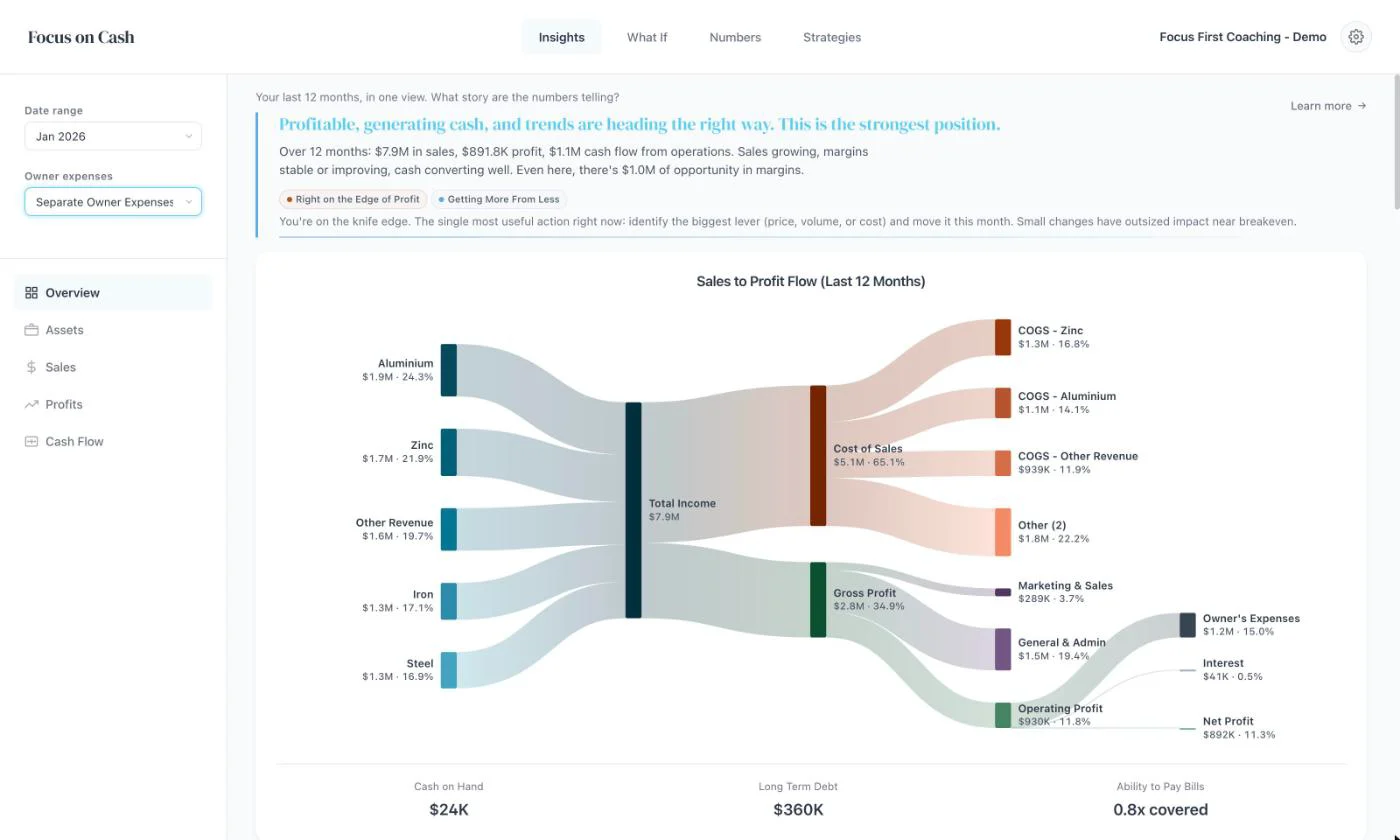
The same switch matters when you sell. A buyer pays for the profit before you, less a wage for someone to do your job. See What is my business worth?
Get started
See your business clearly.
Fill out the form and we will be in touch with next steps. Every plan is billed once a year, with every feature included.
Or email [email protected]