Pricing your work
A small price rise can lift profit a lot.
If your customers stay, a price rise goes straight to profit, because the goods or the work cost you the same. Here is how much it adds, and how many sales you could lose and still be ahead.
Why price moves profit so much
It is like a pay rise for hours you already work. Nothing else changes, so all of it is extra.
Your Cost of Sales stays the same, because you sell the same things. Your overheads stay the same too. So, before tax, every extra dollar of price lands in profit.
- Sales today
- $1,500,000
- Gross Profit today, at 40%
- $600,000
- Sales after a 5% price rise, same customers
- $1,575,000
- Gross Profit after the rise (Cost of Sales unchanged)
- $675,000
5% on price, 12.5% more Gross Profit: $75,000 a year.
At a lower Gross Profit %, the same rise is a bigger percentage of your Gross Profit.
How many sales can you lose and still be ahead?
The usual worry is losing customers. So work out how many you could lose before the rise stops paying.
- Gross Profit on every $100 of sales today
- $40
- Gross Profit on the same sale after a 5% rise
- $45
- Sales needed to keep the same Gross Profit ($40 ÷ $45)
- 89%
You could lose about 11% of your sales volume and still make the same Gross Profit.
This assumes your Cost of Sales falls with the sales you lose. If your direct wages stay the same, you can lose fewer.
Ask how many of your customers would really leave over 5%, and which ones buy on price alone. They are the likeliest to go.
Discounts work the other way
A 5% discount needs about 14% more volume just to stand still, plus the extra work that comes with it.
- Gross Profit on every $100 of sales today
- $40
- Gross Profit on the same sale after a 5% discount
- $35
- Sales needed to keep the same Gross Profit ($40 ÷ $35)
- 114%
You need about 14% more sales volume to make the same Gross Profit.
This is one of the ways a business ends up growing broke: busier, with less to show for it.
Before you raise prices
- Start with the customers or jobs on the lowest Gross Profit %.
- Put new prices on new quotes first. Existing customers get notice and a date.
- Tell customers the reason in a sentence, and the date it starts.
- If your supplier costs rose and your prices did not, you are already behind. Close that gap first.
- Watch Gross Profit % and the number of sales for the next 3 months, so you know what the rise did.
How Focus on Cash shows it
The What If screen has boxes for Sales Price Change and Sales Volume Change. Raise price by 5%, then lower volume to see how many sales you could lose before profit falls. It shows what each change does to Sales, Operating Profit and Net Cash Flow.
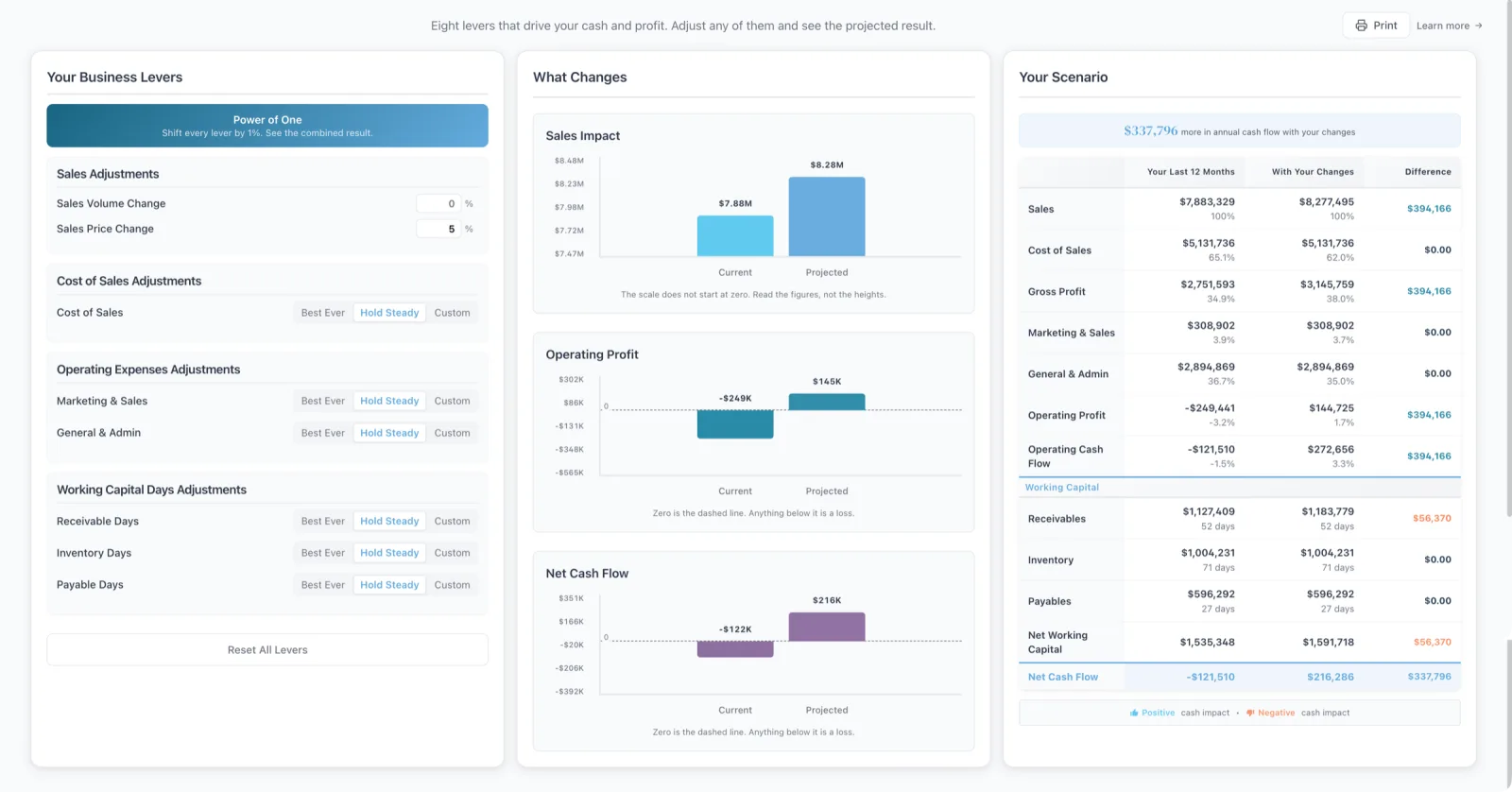
Focus on Cash also flags Getting Less for What You Sell on the Sales screen, when Gross Profit % and the average order value are both falling while sales hold up. It can mean discounting, or prices being pushed down by the market.
Related: Can I afford to hire?, and Cash trapped.
Get started
See your business clearly.
Fill out the form and we will be in touch with next steps. Every plan is billed once a year, with every feature included.
Or email [email protected]