Selling your business
What is my business worth?
A buyer pays for the profit they can keep making, plus the assets they take over. Here is how a buyer counts it, and how much of the price you keep.
How a buyer counts it
Many small businesses are priced from their profit. The buyer takes a year of profit and multiplies it. That part is called goodwill: what they pay for the business’s ability to keep earning.
Then they add the inventory they take over, and often the equipment.
- Yearly profit a buyer would pay for
- $250,000
- Multiple
- × 2.75
- Goodwill
- $687,500
- Plus equipment
- $120,000
- Plus inventory
- $80,000
Sale price: $887,500.
Sales are not in that sum. Two businesses with the same sales can sell for very different prices, because one keeps more of each dollar.
Which profit a buyer pays for
A buyer pays for the profit they will make. Your accounts probably show a different number, for 2 reasons.
The first is your own costs. If your car, phone and other personal costs run through the business, the buyer will not have them. So they add them back.
The second is your job. If you work in the business, someone has to do that work after you leave. A buyer will usually take off a fair wage for that person, with super and other oncosts.
Some brokers price on the profit before the owner’s wage instead, with a lower multiple. Ask which way your broker counts it.
- Profit in the accounts, last 12 months
- $180,000
- Plus the owner’s costs run through the business
- $220,000
- Profit before the owner
- $400,000
- Less a manager’s wage to do the owner’s job, with oncosts
- $150,000
Profit a buyer would pay for: $250,000.
A buyer will also check more than one year. One good year on its own is easy to doubt. Profit that has held up for several years is easier to believe.
What multiple?
The multiple is where a buyer prices risk and potential. Your broker or accountant can tell you the usual range for businesses like yours.
A buyer moves the multiple up when the profit looks safe and there is room to grow it. They move it down for risks, such as a business that needs you every day, or a few customers who make up most of the sales.
That means you can lift the price without lifting profit, by making the profit safer or showing a buyer where it can grow.
Focus on Cash starts at 2.75, and you can change it.
What you keep
The sale price is not what you take home. Broker, legal and accounting costs come off first.
If your business is a company and it sells its assets, the company pays tax on what the sale earns it. The rest of the cash stays in the company until you take it out. Then you pay personal tax on it.
Small business tax concessions can reduce the tax a lot. Ask your accountant which ones apply to you before you agree a price. The Sell screen does not apply them.
How Focus on Cash shows it
The Sell screen, under What If, works through the sale. It averages profit over up to 5 years of 12-month blocks, weighted as you choose. The screen calls this profit EBITDA.
It multiplies that profit by your multiple. It adds Fixed Assets and Inventory from your balance sheet, or the price you have agreed for them. Then it takes off the sale costs and the tax on the sale, and shows the cash retained.
Value the accounts do not show, such as technology, customers or a brand, goes in Strategic Value and is added to goodwill.
The Owner expenses switch in the sidebar changes the profit it starts from. Separate shows the profit before your costs. The screen does not take off a wage for someone to do your job, so allow for that yourself, as in the second box.
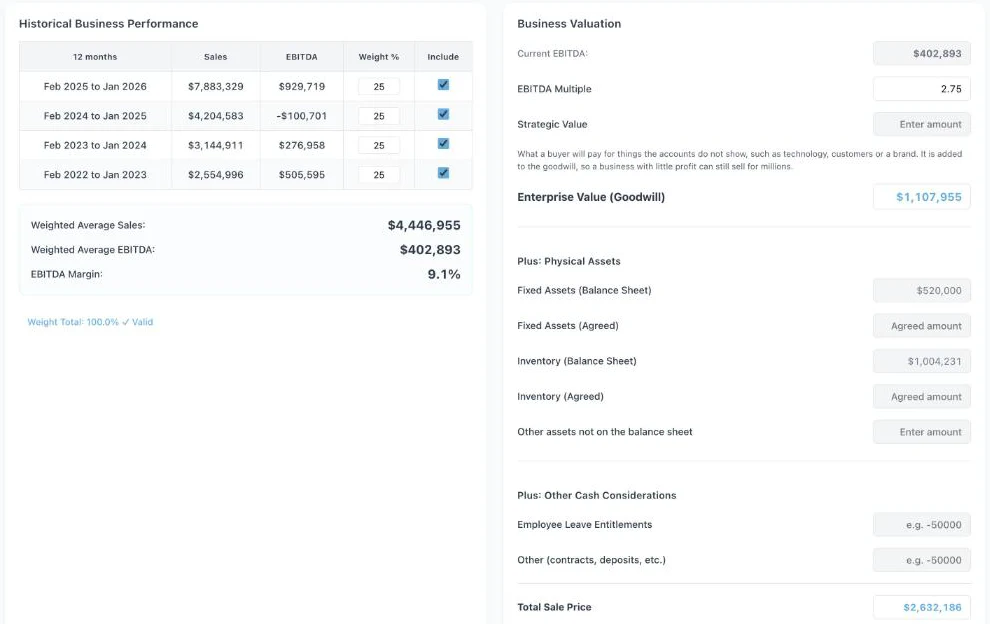
Treat the result as the start of the conversation with your broker and accountant.
Related: How much can the business afford to pay you?, and Should I raise my prices?
Get started
See your business clearly.
Fill out the form and we will be in touch with next steps. Every plan is billed once a year, with every feature included.
Or email [email protected]